It's the sentence you're seeing everywhere: What will you read this summer?
This Sunday's New York Times Book Review has a wonderful article. They invited twelve authors to write briefly about their most memorable summer read. Here's the link: http://www.nytimes.com/2013/06/02/books/review/what-i-read-that-summer.html?src=me
It was interesting to me how much of the readers' reminiscence went back to being children or young adults. I was reminded of the summer of 1960, between sixth and seventh grade, when I read Gone with the Wind, and Leon Uris' Exodus. Exodus had just been published in 1958, and the version we had at home was the newly printed paperback. They were both so engrossing, I barely came up for air. Reading all the time and being totally engrossed wasn't new for me even as a child, but it was astonishing to get caught up in two such intense stories, with love and family drama all wrapped up in war and politics. I haven't forgotten what it felt like to read those books that summer.
Saturday, June 1, 2013

Friday, February 15, 2013
Our Weekend in Iceland
It’s already been two weeks since we went to Iceland for the weekend with our friends Eileen and Wally Powelson. It was a great trip - fast, but great - and gave us a quick look at this fascinating country. Icelandair has these inexpensive packages that include round trip airfare Seattle-Reykjavik, hotel (essentially four nights - you arrive in the early morning and can go right to your room), and a one-day tour of your choice. All this for just $800 per person! And there were a lot of people taking advantage of these deals.
We left Seattle on Thursday afternoon and arrived 7.5 hours later in the early morning at Keflavik airport. The airport is 30 miles or so from Reykjavik. There is good transportation into town, but we had rented a car to give us a bit more flexibility. Since Icelandair only provides food for purchase we got coffee and rolls in the airport.

We didn’t realize that the car rental people were actually waiting for us at the exit! We got our car (after a little fussing to get the correct GPS) and headed into town. We couldn’t see much, as it was still dark. Sunrise in January in Iceland is about 10:30 a.m. - sunset at 5:30! A short day. We arrived at our hotel - the Icelandair Hotel Reykjavik Natura - and were able to go right to our rooms.

The rooms were small but usable, and everything was in good condition. We had breakfast (not included in the room price, but a good breakfast buffet), and then set out to explore Reykjavik. Our hotel was a ways from the town center, and we were glad we had our car. The temperature was in the 30's and there was always a lot of wind and some rain and snow, so it was pretty cold.
One of the first places we went was the architecturally amazing Hallgrimskirkja.

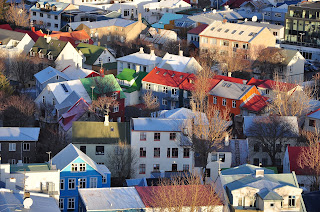
Built in the 20th century to honor one of Iceland’s most famous pastors, it is a beautiful structure inside and out. There’s a Leif Ericksson statue outside. Ericksson was an Icelander - from the family of the first Viking settlers in 860 AD. I thought the statue looked like he was pointing toward the Leif Ericksson statue at Shilshole Bay! We went inside the church. The place is famous for its organ, and we were looking forward to going to Sunday worship there. But the organ is being cleaned and was all over the floor! It’s looks pretty amazing, though, and we were sorry not to be able to hear it. It was a beautiful day - clear blue sky. We went up into the tower and got terrific views all around.
We walked further into the town, beginning the hunt for a new Icelandic sweater for Monte Krog! (The subtext of the trip.) We all decided after a few turns along the streets that it was time for a nap! (These weekend excursions may be for younger people!) So we went back to the hotel and had good long naps and gather again to go for dinner. We had three dinner meals and they were all excellent. We were the only people in this restaurant - Fjalakotturinn: french cooking with local food - and we all had superb meals. We had a great visit with our server, Matthias, who was a Ph.D student at the University of Iceland in Human Geography. He gave us some tips on what to see and where, and we enjoyed our conversation.
The next day was a our tour day. We left the hotel at 11:30 a.m. There were 8 on the tour in a small van - just right. Besides us there was a couple from Boston and a couple from Vancouver, B.C. Our driver and guide was a young woman named Dana, and she was very good.
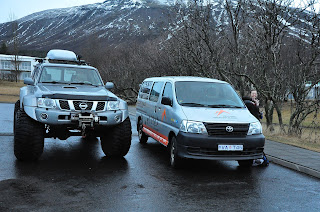
We were surprised to learn later in the day that she is actually from the Czech Republic! She clearly loves her new Icelandic home. The tour company is Icelandic Mountain Guides, and we would recommend them.
The name of our tour was Golden Circle, and included a visit to the main Icelandic historic site, a big waterfall, some geysers, time at a geothermal spa, and, if possible, seeing the Aurora Borealis. It’s a quite common tour (one book noted that there’s nothing “Golden” or “Circle” about it - should be called the “Mossy Green Triangle”) but we thought it a good one to get a sense of the place, and it provided us with that experience.
We started out at Thingvillar, the place where the Althing, the Icelandic parliament, was established in 930. It was interesting for me to learn that there were no humans on Iceland prior to the arrival of the Vikings in 860. The parliament formed proclaimed freedom from royal rule and established a partnership between the first families to settle Iceland. Iceland is still not very big. Only 320,000 people live there. But they are very proud of their heritage, and this place is a sacred site for them.

 Wally and Eileen braved the stormy weather and walked down the hill to the small church and met the rest of us in the parking lot. There we were at the rift valley where the American tectonic plate meets the European one - virtually at the meeting of Europe and America!
From there we went to one of Icelands many huge waterfalls. This one is Gullfoss, or Golden Falls. It is huge, and was beautiful to see in the winter as much of it is frozen. The frozen spray on the edges adds such a gorgeous pattern to the whole area.


We had lunch here, and then headed off to a geothermal site to see geysers. The word “geyser” is Icelandic in origin. It is actually the name of one geyser, and from there has become the word for geysers everywhere. The actual word for the phenomena in Icelandic is different! The area was very interesting, and we stood and watched their own “Old Faithful” which erupts every seven minutes.
 From there we went to a geothermal spa called Fontana on a large lake. On the way we stopped to see some Icelandic horses. They are their own breed. No other horses can be imported into Iceland to protect these lovely animals, and if one is taken off Iceland it cannot return. They have an interesting genetic possibility: some have a special gait where they can lift the hooves on the same side of their bodies!

 We changed to bathing suits and joined in the fun in the pools and the steam huts. Fairly amazing how warm it all is! After the bathing, we had dinner at another very good restaurant nearby. This dinner was included in the tour.
After dinner we tried looking for Aurora Borealis, but it was cloudy and rainy and there were none to be seen. We did go walk on a black sand beach on the Atlantic late at night - an interesting experience! We got back to our hotel around midnight.
The next day, after another walk in the city including the Sunday flea market,

we set off to see something of the west coast. It is an amazing landscape.

We drove through a tunnel that went under a fjord! We had lunch in the historic village of Borgarnes,

and then headed back to Reykjavik as the weather was changing rapidly with lots of snow coming down! We did see many of these greenhouses which are all heated with geothermal energy. Iceland grows all its own fruits and vegetables, including bananas, in these greenhouses.

We got back safely. After a little break, we went to our dinner reservation at The Fish Market, a very popular Asian fusion restaurant. We again had a superb meal.
Monday was departure day. After checking out of our hotel we went back into town to finish the Monte Krog sweater purchase. We had a nice time doing it at the Icelandic Handknitters Association, a cooperative of 200 handknitters from all over Iceland. We looked around a little more in Reykjavik and then headed towards the airport. On the way we went to the Blue Lagoon, a very famous geothermal spa right near Keflavik.


Larry took a lot of pictures while Eileen, Wally, and I went into the pools. The water is a gorgeous blue color, set off even more in winter by the snow-covered stark mountains around. We had lunch there and then went to the airport, left our car, got checked in and got ready to leave. Our flight departed on time, and we arrive a few minutes early into SeaTac. It was a great experience all around. We’d be happy to explore more of Iceland another time. If you fly Icelandair to Europe, you can stay up to one week in Iceland for no additional flight charges. A good deal all around!
One other note: my seminary professor and friend Daniel Simundson had died the week before. His service at Luther Seminary was on February 4, our last day in Iceland. Dan was a proud Icelander. His parents had come to Pt. Roberts, Washington, where there was a thriving Icelandic community. Dan traveled to Iceland often over the years. In 2000 the University of Iceland gave him an honorary degree, which pleased him very much. And I was pleased very much to be in Iceland on the day of his service. Perfect.
We left Seattle on Thursday afternoon and arrived 7.5 hours later in the early morning at Keflavik airport. The airport is 30 miles or so from Reykjavik. There is good transportation into town, but we had rented a car to give us a bit more flexibility. Since Icelandair only provides food for purchase we got coffee and rolls in the airport.

We didn’t realize that the car rental people were actually waiting for us at the exit! We got our car (after a little fussing to get the correct GPS) and headed into town. We couldn’t see much, as it was still dark. Sunrise in January in Iceland is about 10:30 a.m. - sunset at 5:30! A short day. We arrived at our hotel - the Icelandair Hotel Reykjavik Natura - and were able to go right to our rooms.

The rooms were small but usable, and everything was in good condition. We had breakfast (not included in the room price, but a good breakfast buffet), and then set out to explore Reykjavik. Our hotel was a ways from the town center, and we were glad we had our car. The temperature was in the 30's and there was always a lot of wind and some rain and snow, so it was pretty cold.
One of the first places we went was the architecturally amazing Hallgrimskirkja.

Built in the 20th century to honor one of Iceland’s most famous pastors, it is a beautiful structure inside and out. There’s a Leif Ericksson statue outside. Ericksson was an Icelander - from the family of the first Viking settlers in 860 AD. I thought the statue looked like he was pointing toward the Leif Ericksson statue at Shilshole Bay! We went inside the church. The place is famous for its organ, and we were looking forward to going to Sunday worship there. But the organ is being cleaned and was all over the floor! It’s looks pretty amazing, though, and we were sorry not to be able to hear it. It was a beautiful day - clear blue sky. We went up into the tower and got terrific views all around.

We walked further into the town, beginning the hunt for a new Icelandic sweater for Monte Krog! (The subtext of the trip.) We all decided after a few turns along the streets that it was time for a nap! (These weekend excursions may be for younger people!) So we went back to the hotel and had good long naps and gather again to go for dinner. We had three dinner meals and they were all excellent. We were the only people in this restaurant - Fjalakotturinn: french cooking with local food - and we all had superb meals. We had a great visit with our server, Matthias, who was a Ph.D student at the University of Iceland in Human Geography. He gave us some tips on what to see and where, and we enjoyed our conversation.
The next day was a our tour day. We left the hotel at 11:30 a.m. There were 8 on the tour in a small van - just right. Besides us there was a couple from Boston and a couple from Vancouver, B.C. Our driver and guide was a young woman named Dana, and she was very good.

We were surprised to learn later in the day that she is actually from the Czech Republic! She clearly loves her new Icelandic home. The tour company is Icelandic Mountain Guides, and we would recommend them.
The name of our tour was Golden Circle, and included a visit to the main Icelandic historic site, a big waterfall, some geysers, time at a geothermal spa, and, if possible, seeing the Aurora Borealis. It’s a quite common tour (one book noted that there’s nothing “Golden” or “Circle” about it - should be called the “Mossy Green Triangle”) but we thought it a good one to get a sense of the place, and it provided us with that experience.
We started out at Thingvillar, the place where the Althing, the Icelandic parliament, was established in 930. It was interesting for me to learn that there were no humans on Iceland prior to the arrival of the Vikings in 860. The parliament formed proclaimed freedom from royal rule and established a partnership between the first families to settle Iceland. Iceland is still not very big. Only 320,000 people live there. But they are very proud of their heritage, and this place is a sacred site for them.


From there we went to one of Icelands many huge waterfalls. This one is Gullfoss, or Golden Falls. It is huge, and was beautiful to see in the winter as much of it is frozen. The frozen spray on the edges adds such a gorgeous pattern to the whole area.


We had lunch here, and then headed off to a geothermal site to see geysers. The word “geyser” is Icelandic in origin. It is actually the name of one geyser, and from there has become the word for geysers everywhere. The actual word for the phenomena in Icelandic is different! The area was very interesting, and we stood and watched their own “Old Faithful” which erupts every seven minutes.


 We changed to bathing suits and joined in the fun in the pools and the steam huts. Fairly amazing how warm it all is! After the bathing, we had dinner at another very good restaurant nearby. This dinner was included in the tour.
 After dinner we tried looking for Aurora Borealis, but it was cloudy and rainy and there were none to be seen. We did go walk on a black sand beach on the Atlantic late at night - an interesting experience! We got back to our hotel around midnight.
The next day, after another walk in the city including the Sunday flea market,

we set off to see something of the west coast. It is an amazing landscape.

We drove through a tunnel that went under a fjord! We had lunch in the historic village of Borgarnes,

and then headed back to Reykjavik as the weather was changing rapidly with lots of snow coming down! We did see many of these greenhouses which are all heated with geothermal energy. Iceland grows all its own fruits and vegetables, including bananas, in these greenhouses.

We got back safely. After a little break, we went to our dinner reservation at The Fish Market, a very popular Asian fusion restaurant. We again had a superb meal.
Monday was departure day. After checking out of our hotel we went back into town to finish the Monte Krog sweater purchase. We had a nice time doing it at the Icelandic Handknitters Association, a cooperative of 200 handknitters from all over Iceland. We looked around a little more in Reykjavik and then headed towards the airport. On the way we went to the Blue Lagoon, a very famous geothermal spa right near Keflavik.


Larry took a lot of pictures while Eileen, Wally, and I went into the pools. The water is a gorgeous blue color, set off even more in winter by the snow-covered stark mountains around. We had lunch there and then went to the airport, left our car, got checked in and got ready to leave. Our flight departed on time, and we arrive a few minutes early into SeaTac. It was a great experience all around. We’d be happy to explore more of Iceland another time. If you fly Icelandair to Europe, you can stay up to one week in Iceland for no additional flight charges. A good deal all around!
One other note: my seminary professor and friend Daniel Simundson had died the week before. His service at Luther Seminary was on February 4, our last day in Iceland. Dan was a proud Icelander. His parents had come to Pt. Roberts, Washington, where there was a thriving Icelandic community. Dan traveled to Iceland often over the years. In 2000 the University of Iceland gave him an honorary degree, which pleased him very much. And I was pleased very much to be in Iceland on the day of his service. Perfect.
Wednesday, October 3, 2012
Gaudy Night, continued
In the "Author's Note" at the beginning of the novel, Sayers writes an apology to the "City and University of Oxford" for shifting some streets, adding a college, and for "having saddled [Balliol College] with so wayward an alumnus as Peter Wimsey... ." But the first paragraph concludes with this sentence: "Detective-story writers are obliged by their disagreeable profession to invent startling and unpleasant incidents and people, and are (I presume) at liberty to imagine what might happen if such incidents and people were to intrude upon the life of an innocent and well-ordered community; ... ." It is precisely the "startling and unpleasant incidents and people" that she addresses in this novel, and not just the outward form of a very unhappy story that makes up the detective puzzle. She is also addressing the intrusion of women into the "innocent (?) and well-ordered community" of men in ancient and newer roles, and against their expectations.
Right at the outset of the story, when Harriet Vane arrives at Shrewsbury College for the Gaudy (like a reunion), all of the women gathered - the oldest of whom, like Sayers, had fought for women to receive degrees at all - are talking about proper roles. As she meets old classmates, Harriet observes how some have seemingly thrown away their academic achievements for the traditional domestic virtues, while others have maintained a solid professional life despite the hazards of the culture. (Gaudy Night was written in 1937. This period between the World Wars in England is a fascinating time of opening all kinds of pathways for women who found themselves in a culture where so many of the men had died in warfare.)
At the end of chapter 1, Sayers puts these words in the mouth of one of the scholars of the college. Harriet says to Miss de Vine, at the end of a conversation about detachment and feelings, "...between one desire and another, how is one to know which things are really of overmastering importance?" Miss de Vine replies, "We can only know that ... when they have overmastered us."
A major theme of the novel is that of proper work and of finding your own passion and fulfilling it. In a conversation with a woman who had been an outstanding scholar, but had married a Welsh farmer and given it all up, Harriet says, "I'm sure one should do one's own job, however trivial, and not persuade one's self into doing somebody else's, however noble. And the theme of women making their way in the world of men returns time and again. Miss Hillyard, the history tutor and no fan of Harriet, has a conversation with her where she talks about women at the university. She says, "All the men have been amazingly kind and sympathetic about the Women's Colleges. Certainly. But you won't find them appointing women to big University posts. That would never do. The women might perform their work in a way beyond criticism. But they are quite pleased to see us playing with our little toys." This theme of the "proper job" and of how doing influences all of our relationships runs through every level of this story, from the relationship of the Women's Colleges to the rest of the University, to the relationship between Peter and Harriet, to the relationships of the women among themselves, and to the basic effect of the tragic story of the mystery.
Right at the outset of the story, when Harriet Vane arrives at Shrewsbury College for the Gaudy (like a reunion), all of the women gathered - the oldest of whom, like Sayers, had fought for women to receive degrees at all - are talking about proper roles. As she meets old classmates, Harriet observes how some have seemingly thrown away their academic achievements for the traditional domestic virtues, while others have maintained a solid professional life despite the hazards of the culture. (Gaudy Night was written in 1937. This period between the World Wars in England is a fascinating time of opening all kinds of pathways for women who found themselves in a culture where so many of the men had died in warfare.)
At the end of chapter 1, Sayers puts these words in the mouth of one of the scholars of the college. Harriet says to Miss de Vine, at the end of a conversation about detachment and feelings, "...between one desire and another, how is one to know which things are really of overmastering importance?" Miss de Vine replies, "We can only know that ... when they have overmastered us."
A major theme of the novel is that of proper work and of finding your own passion and fulfilling it. In a conversation with a woman who had been an outstanding scholar, but had married a Welsh farmer and given it all up, Harriet says, "I'm sure one should do one's own job, however trivial, and not persuade one's self into doing somebody else's, however noble. And the theme of women making their way in the world of men returns time and again. Miss Hillyard, the history tutor and no fan of Harriet, has a conversation with her where she talks about women at the university. She says, "All the men have been amazingly kind and sympathetic about the Women's Colleges. Certainly. But you won't find them appointing women to big University posts. That would never do. The women might perform their work in a way beyond criticism. But they are quite pleased to see us playing with our little toys." This theme of the "proper job" and of how doing influences all of our relationships runs through every level of this story, from the relationship of the Women's Colleges to the rest of the University, to the relationship between Peter and Harriet, to the relationships of the women among themselves, and to the basic effect of the tragic story of the mystery.
Monday, October 1, 2012
Gaudy Night
On Friday a group of us are going to see the Taproot Theater's adaptation of Dorothy L. Sayers' novel Gaudy Night. One theater-goer, a Holden friend from Minneapolis who's here for a conference, first suggested the outing. I'd seen the advertizing, but hadn't yet determined to go. But she noted a remark I had made long ago: If I were marooned on a desert island the books I'd like would be the Bible and Gaudy Night, and not necessarily in that order!
I believe I first read Gaudy Night in 1971. The feminist movement was beginning to be in full swing, and my life had certainly been filled both with opportunities to grow as an independent young woman, and with many terrific role models. This book was the first one that described the cultural and historical issues around women in a way that was quite powerful for me.
This upcoming theater outing has made me very reflective about my own history as a woman in a "man's job," and of the whole sweep of the last century around these changes. And there is a little anxiety that we are moving a bit backwards in this regard.
So this week I'm going to re-read Gaudy Night and reflect on my reading in this blog. This morning's Seattle Times published an editorial that bears reading in the context: http://seattletimes.com/html/opinion/2019291724_parkercolumngloriaxml.html
I believe I first read Gaudy Night in 1971. The feminist movement was beginning to be in full swing, and my life had certainly been filled both with opportunities to grow as an independent young woman, and with many terrific role models. This book was the first one that described the cultural and historical issues around women in a way that was quite powerful for me.
This upcoming theater outing has made me very reflective about my own history as a woman in a "man's job," and of the whole sweep of the last century around these changes. And there is a little anxiety that we are moving a bit backwards in this regard.
So this week I'm going to re-read Gaudy Night and reflect on my reading in this blog. This morning's Seattle Times published an editorial that bears reading in the context: http://seattletimes.com/html/opinion/2019291724_parkercolumngloriaxml.html
Monday, May 7, 2012
Tofino
A beautiful morning with a 0.0 ft. tide. Chesterman Beach at its best.
Larry has been here since Wednesday, I arrived yesterday after an intense four days of a women's choir festival in Vancouver. Check out the article from the Vancouver Sun. http://www.vancouversun.com/entertainment/Elektra+Women+Choir+helps+create+Tapestry/6555158/story.html
Larry has been here since Wednesday, I arrived yesterday after an intense four days of a women's choir festival in Vancouver. Check out the article from the Vancouver Sun. http://www.vancouversun.com/entertainment/Elektra+Women+Choir+helps+create+Tapestry/6555158/story.html
Sunday, April 8, 2012
Easter Day
Break the box and shed the nard;
Stop not now to count the cost;
Hither bring pearl, opal, sard;
Reck not what the poor have lost;
Upon Christ throw all away:
Know ye, this is Easter Day.
Build God’s church and deck the shrine;
Empty though it be on earth;
Ye have kept your choicest wine-
Let it flow for heavenly mirth;
Pluck the harp and breathe the horn:
Know ye not 'tis Easter mom?
Gather gladness from the skies;
Take a lesson from the ground;
Flowers do ope their heavenward eyes
And a Spring-time joy have found;
Earth throws Winter's robes away,
Decks herself for Easter Day.
Beauty now for ashes wear,
Perfumes for the garb of woe.
Chaplets for dishevelled hair,
Dances for sad footsteps slow;
Open wide your hearts that they
Let in joy this Easter Day.
Seek God's house in happy throng;
Crowded let the table be;
Mingle praises, prayer and song,
Singing to the Trinity.
Henceforth let your souls alway
Make each morn an Easter Day.
-- Gerald Manley Hopkins
Stop not now to count the cost;
Hither bring pearl, opal, sard;
Reck not what the poor have lost;
Upon Christ throw all away:
Know ye, this is Easter Day.
Build God’s church and deck the shrine;
Empty though it be on earth;
Ye have kept your choicest wine-
Let it flow for heavenly mirth;
Pluck the harp and breathe the horn:
Know ye not 'tis Easter mom?
Gather gladness from the skies;
Take a lesson from the ground;
Flowers do ope their heavenward eyes
And a Spring-time joy have found;
Earth throws Winter's robes away,
Decks herself for Easter Day.
Beauty now for ashes wear,
Perfumes for the garb of woe.
Chaplets for dishevelled hair,
Dances for sad footsteps slow;
Open wide your hearts that they
Let in joy this Easter Day.
Seek God's house in happy throng;
Crowded let the table be;
Mingle praises, prayer and song,
Singing to the Trinity.
Henceforth let your souls alway
Make each morn an Easter Day.
-- Gerald Manley Hopkins
Saturday, April 7, 2012
Holy Saturday.
All night had shout of men and cry
Of woeful women filled his way;
Until that noon of sombre sky
On Friday, clamour and display
Smote him; no solitude had he,
No silence, since Gethsemane.
Public was death; but power, but might,
But life again, but victory,
Were hushed within the dead of night,
The shuttered dark, the secrecy.
And all alone, alone, alone,
He rose again behind the stone.
-Alice Meynell
Of woeful women filled his way;
Until that noon of sombre sky
On Friday, clamour and display
Smote him; no solitude had he,
No silence, since Gethsemane.
Public was death; but power, but might,
But life again, but victory,
Were hushed within the dead of night,
The shuttered dark, the secrecy.
And all alone, alone, alone,
He rose again behind the stone.
-Alice Meynell
Subscribe to:
Posts (Atom)
