Friday, October 2, 2015

Westport


We took our leave of Gurteen (we thought) and headed out to see megalithic tombs at Carrowkeel. We had been told this was a bit of hike. It was a long hike, but really worth it. We walked very high on top of a hill to see three on 21 megalithic tombs. They are all around on top of the hills. Pretty amazing. They are older than the pyramids. Although it was a foggy and misty day, we had terrific views all around. Very much worth the time and effort.

Friendly Sheep on the Way Up Carrowkeel


Megalithic Tomb


We got back on the road and headed for Westport. We can call these days in Ireland “Burning Up the N5.” We got to our B and B, which was just a couple block from the centre. We walked around for a while and scouted out dinner and music. We had a “Stick with Rick” dinner at a place called Mangoes, which was excellent - beautiful fish/seafood. Then we went and hung out at Matt Molloy’s to wait for music. We got there around 8:30, claimed two seats in the music room and ordered a couple half pints of Guinness. Mine was Guinness and Black, which is Guinness with blackcurrant juice, Yum! Learned it from the Australians in Gurteen.

Matt Molloy is the flutist with the Chieftans, and he started this pub a few years ago. He wasn’t there, but we figured that’s a good pedigree to attract really good players. Even our twenty-something server at the restaurant said, “Matt Molloy’s” when we said we were looking for music. It got crowded and more crowded. People were coming and going to two other spots beyond the room - a smokers place and another outside bar. (The weather was finally turning for the better. It rained all summer in Ireland. Everyone talked about it everywhere we went.) We were perched on two stools right on the edge of where everyone walked. My knees touched stranger’s body parts in unexpected ways. Eventually, the musicians started arriving. When they were all gathered, there were two boxes (accordions), two bhodrans (drums), three fiddles, and a guitar. The lead fiddler started a tune and then they all joined in. It was grand. We are so happy we took the time to do this. A great experience.


We got in late to our B and B after a truly wonderful evening.

Falduff and Louisburgh

We were on the ancestor track again to today, heading west through Westport and out on the peninsula to Louisburgh. We stopped on the way in Ballagharderreen and picked up our laundry.
In Falduff/Louisburgh we had a specific piece of land to find which Larry’s great-grandfather Dominick had rented and worked before leaving Ireland for the US. We made our way down a road and we indeed found exactly the place Sean Quinn had marked for us on the land survey map, Pretty amazing. The perimeter is exactly as it was in 1842. There were lovely sheep grazing. Pictures were taken. We explored further on the lane and started taking to a couple who were out for a walk. They asked what we were doing and we told them. The young man said, “Howard. That’s an English name, isn’t it? But my name is Maxwell, which is Scottish, and we’ve been here for generations!” Then they both said, “You need to ask Tony. His farm is right here.” Right after that we heard some loud pounding and the young man yelled out, “Tony!” Then Tony came to where we were and parted the hedge and we started talking. He knew everything, including that there had been some Howards around. He also knew all about the Garvey family who had owned the land Dominick rented. There are very long memories in these parts!
Dominick Howard's Rental Land

Tony

 After we finished our in-the-hedge conversation with Tony, we went back along the land to the really old cemetery - again, an old priory, nuns this time. We walked through the rugged and middy old cemetery, but did not find Howards. We do expect that, if they are there, they are marked by the uncarved little rocks that are in ancient rows everywhere. When the rain came, we headed back to the car and into Louisburgh for a cup of tea. We ate at the Louisburgh 74, a great liittle café. Yummy seafood chowder and a prawn mayonnaise sandwich with salad. We got talking to another local who knew a few names and so on. All the history is hear in the conversation. This man also noted how difficult this all is in Ireland because of the long history of English land ownership. He thought they might be able to think about something else in about two more generations.

After lunch we went out to the end of the peninsula and went to the little town of Killeen where we think Dominick’s friend Patrick Curran was from. They share a grave marker in Watertown, New York - one side Dominick, the other Patrick. And Patrick’s says “Killeen, County Mayo” on it. We tried again for Curran graves with no luck. But it would indeed be great luck if we ever found any of these.

We headed back to Gurteen and guess what! We had dinner at the pub. We had met some Australians from Melbourne two nights before, and tonight we had a long conversation with one of them. Lots of fun.

This was our last night in Gurteen. We had considered staying one more, but we decided we wanted to go back to Westport to see that nice town and to finally hear a music session.


Gurteen and the Coleman Music Center


We really needed to laundry and Jacci, our b and b host, said she could take it for us to the Laundrette in then nearby larger town. Very nice. We had a relaxed morning and then visited the Michael Coleman music center. Michael Coleman was a very famous Irish fiddler from the early 20th century. He was from the Gurteen area and this traditional mucis center was named to honor him. It is a really terrific place. They not only have seminars year-round to which people from all over the world come, but they also do concerts and educational events. It’s all part of a larger 30-year or so movement to Ireland to preserve the old music and traditions, including the language. The museum part is excellent. It reminded us of the Bach museum in Eisenstadt without the hanging chairs. Really good and easily accessible digital units that let you learn what each instrument does and alone and with others. They also let you listen to the musicians who have been central to the whole revival of Irish traditional music. We had a great visit with the two women working there and learned even more from them. To this point we had been unable to be where there was pub music, and had missed it there. We were still looking! Part of the issue is that it always starts late at night, so you want to be where you can walk home! Check out the Coleman center here: http://www.colemanirishmusic.com/


We also drove north and saw the town of Ballymote and its ancient castle ruins, and Larry finally found a great picture of a pile of peat.

Peat                                                                                                                             

The day ended with another great meal in the pub. (There’s a pattern here.)


Athenry to Gorteen (Gurteen)


The next day was a genealogy day, heading for Athenry, just a few km east of Galway. We’d been looking for ordnance survey maps and hadn’t been able to find the quadrants we needed. It took us a while to track them down at two different Galway bookstores, but we got it done.

Athenry is the place where possibly Larry’s Howard relatives came from. We were looking for a Thomas Howard, who would be the great great grandfather (married to the aforementioned Flynn - Elinor). We had a good look around, checked out the castle and asked questions (“Howard - that’s an English name, isn’t it?”) and walked in a very old cemetery at an old Dominican priory. There are lots of these old abbeys, priories, monasteries, castles, and towers all over the place. The cemetery yielded no Howards. But every cemetery has lots and lots of very old small stones scattered all around marking unnamed graves. A very hard thing to do. Some cemeteries, we found, have helpful lists of those buried there. One in Athenry did, but no Howards. We did have good conversations, saw lovely things, and had an afternoon beer in the local pub.


Old Dominican Priory and Graveyard, Athenry
 When we left Athenry we went a very short distance north to a land area called Ballydavid North where we know Thomas Howard farmed. In Ireland land and tax records are really the only records available to find anyone because all the records were burned in the Civil War. So nothing else exists from 1921-1901. Finding your Irish roots is a tricky item. If someone didn’t own land or work for someone who owned land (that would be Larry’s family) you can’t find much. When someone rented land from an owner, their name was included in that owner’s tax record. That is very helpful these 150+ years later. We found Ballydavid North and took some pictures of the land in the exact location. Cool.
Ballydavid North
The Crossbar, Gurteen
We then headed north to Gorteen (pronounced, and sometimes spelled Gurteen) where we were booked at the Church View Guest House for three nights. Gurteen looked to be equidistant between Athenry and Louisburgh, the two main areas where we were exploring Larry’s family. We checked in to our lovely room and then went next door to the pub for a great dinner. There is a really good cook in The Crossbar Pub in Gurteen, County Sligo.

The Wild Atlantic Way


We followed what is called The Wild Atlantic Way, a road marking to identify the spectacular views on Ireland’s West coast. When we left Parknasilla, we went inland to the little town of Kenmare, a favorite in the Rick Steves’ Ireland book. We were looking for a better road atlas (found it, finally) and checked out a bookstore. We’ve found Rick’s book very helpful. Our motto is “Stick with Rick!” We don’t follow all his recommendations, but they give us context and helpful guidance. And we have them on our phones with Kindle so there are no travel guide books to haul around!

Another really helpful tool is the app maps.me. We learned about this from our friend John Williams who has used it in remote locations in Southeast Asia and other places. It doe GPS locating on your smartphone and runs the map and does routing all without the phone being connected to wi-fi or cellular service. Really great. Check it out.

Continuing the car repair, we stopped in Killarney at a Ford dealership to see if someone could turn off the low tire (that sould be “tyre”) alert light. Even though we have a Škoda Octavia car, the Ford person found the right menu (totally accessible to us if we could figure it out) and turned off the light. No charge. Good Irish friendliness and hospitality we are experiencing everywhere.

We headed north up the coast, driving across one peninsula to the town of Tarbert where we caught a ferry across the Shannon.

Ferry Across the Shannon

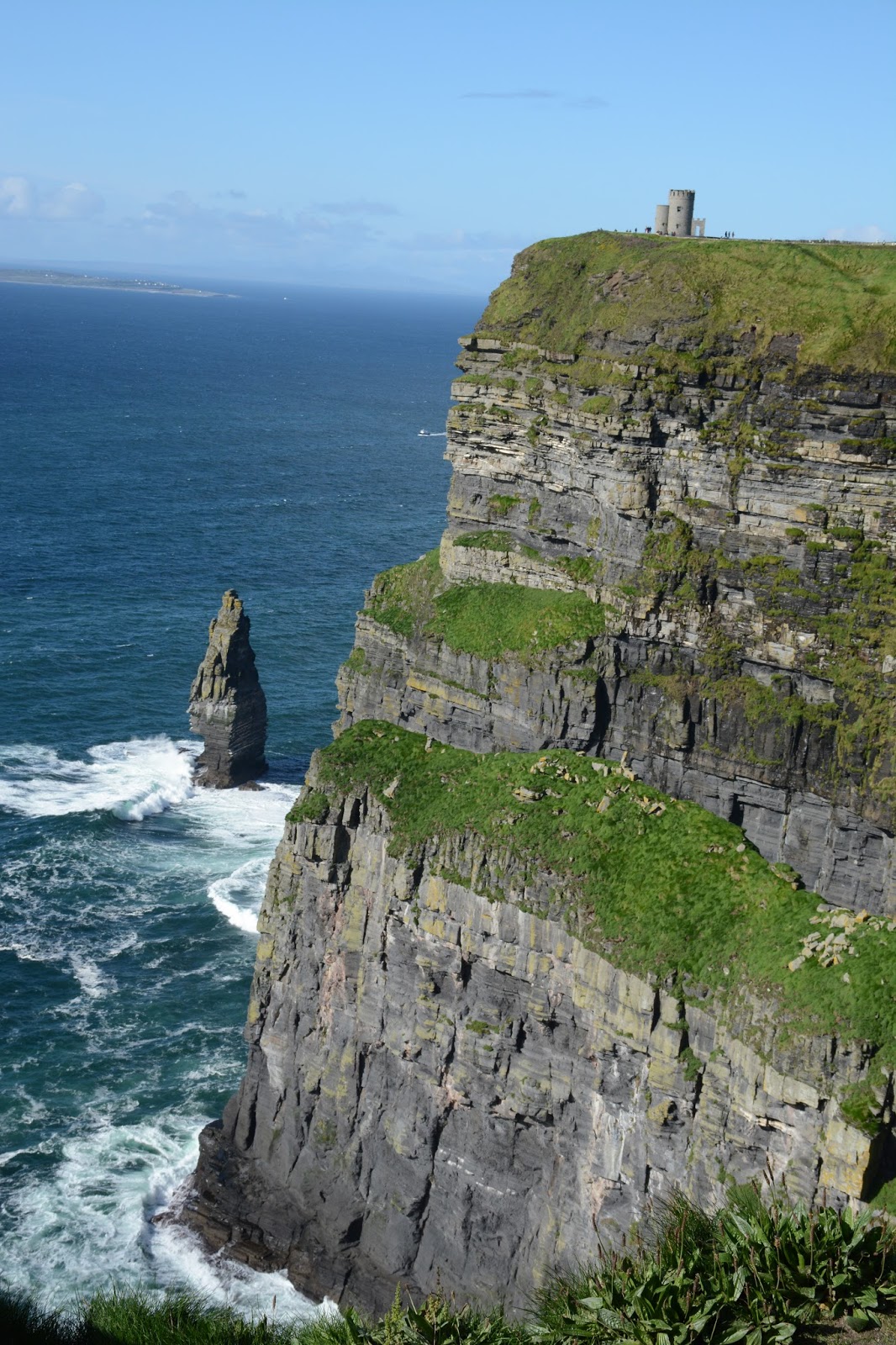
 We continued along the coast until we came to the amazing Cliffs of Moher (pronounced “more”). These spectacular cliffs, home to all kinds of birds and animals including Puffins, were pretty amazing to see. We had a very windy walk, again with people from all over the world, and then continued on our way.
The Cliffs of Moher
 We stopped briefly in the little seaside town of Doolin. Doolin is a very famous music venue where people from everywhere used to show up for sessions in the local pubs. As traditional Irish music has become so popular everywhere, fewer people show up in the this rather remote village. But we came here for a very special purpose. Our neighbors at home had two cats named Huxley and Doolin. They were part of the south end of 44th Ave NE cat gang that included our own Little and Teasel. All have now died. But Doolin was named for this little Irish town, so we took this picture and sent it off to our neighbors “In Memoriam.”


We ended the day in a Galway suburb called Oranmore. Our hotel had a a peppy little Italian bistro with lots of families having dinner. We had great pizza.

Thursday, October 1, 2015

Delay

Hi dear readers. I'm up to date with the blog but can't post because of unreliable Internet. 

Clogheen and the Ring of Kerry


Much of the Ireland part of our trip is focused on finding the homelands of Larry’s ancestors. As noted above, we done a fair amount of work and hired some help along the way. The little town of Clogheen is one place we went to look for Flynns, relatives of Larry maternal great great grandparents. It’s in County Tipperary, and it wasn’t a long way to get there! Before we went to the old graveyard we found a road to a place called The Vee. It took us up to a high place with an amazing view between two hills, hence “The Vee.” Word has it that Johnny Cash went up there and then wrote his song Forty Shades of Green. There were also two hikers huts and a big statue (recent) of the Virgin.

The View from the Vee

We went back down and found the old Shanrahan graveyard and even some Flynns! We don’t know if they are related, but it is a link. It’s an interesting exercise to walk among all these gravestones and see all the stories that are held in those names. The graveyards are tended and people clearly keep up their families tombs. Ireland is very religious, and I’ve been a bit surprised at just how much. Perhaps I’m a bit Seattle-jaded at that point, but the practice of Christianity is very active and wide-spread. Daily masses appear to be well-attended, and one Saturday evening we drove by two churches that were just crammed with cars and peoples going to Saturday evening mass.

Parknasilla
From Clogheen we headed to southwest Ireland. We had hoped to get to Dingle and it’s reputedly lovely peninsula, but we could not find accommodation. Things have been really booked up everywhere. So we tried the Ring of Kerry, just south of there. We ended up doing a bit of a splurge at a place called Parknasilla, a resort that used to be an old railway hotel. It was great. A fantastic and beautiful and worth the splurge.


On our way there, coming through some road work, we had a flat tire - puncture around here. We were just coming into the little town of Sneem and found the local garage. That was worth the price of admission! Turns out we picked up a drill bit, of all things. Larry has kept it as a souvenir. The tire was repaired and we were on our way. Look closely at the photo to see an important tool in an Irish garage.