Friday, April 8, 2011
On the Way to the Villa
There are many things to update in the blog: Halstatt, Austria, Szeged, Hungary. Bled, Slovenia, Venice, and now Ravenna. But it will all have to wait until we are at the Villa in Vasanello, Umbria. We get there tomorrow. We pick up Wally and Eileen Powelson and Eileen's sister Jean the Rome airport, and then begin another wonderful two weeks at Le Terrae! There will be time there to write it all down. Stay tuned!

Tuesday, April 5, 2011
Eisenach
We were in Eisenach one week ago - the last stop on our Luther/Bach journey. Luther studied there as a high school student (essentially), and the Wartburg, where Luther translated the New Testament into German, sits on a high hill overlooking the town. Bach was born and grew up there.
We found a wonderful place to stay - the Haus Hainstein. Owned by the Evangelische Kirche, it sits right on the edge of the forest on the way to the Wartburg. We had a wonderful room with a view of the Wartburg. Here's the picture from our room: The hotel has a history as a place for youth. I was surprised to see a statue of Nathan Soderblom,, the great Swedish theologian, Bishop of Uppsala, and father of the ecumenical movement, in the hotel's front garden. No one could really explain why, except that he had been involved with the place at the beginning of the 20th century. And here is a Holden Village connection! Dr. Conrad Bergendorf worked for Soderblom when Bergendorf was a young pastor. He went on to be president of Augustana College, Rock Island, Illinois, and in that context (and the Carroll Hinderlie connection) came to Holden Village in the 1960's and '70's! Here is a picture of Haus Hainstein:
 The first afternoon in Eisenach we went to the Bachhaus. This is another wonderful Bach museum. We really enjoyed all the excellent displays. There was a concert in the afternoon showcasing Bach's keyboard music on four different instruments from his time. It was very good. They have done a really superb job of showing the whole spread of his music in a variety of ways. Here's a picture from one of the listening stations where Nancy is listening to Cantata 140, "Wake, Awake":
 The next day we walked through the woods to the Wartburg. It was a lovely morning. We so enjoyed our walk and all the scenery. The tour of the place was interesting, but there wasn't much English, even though the tour guide did his best. We had no idea that the place had such a rich and powerful history besides the Luther stuff which is almost presented as an afterthought. His study where he translated the New Testament looked out into the castle courtyard. I'd like to think he often saw the amazing views on all sides as well.
We went to the Lutherhaus in Eisenach as well, which tries re-create the school Luther attended as a teenager. It's very small, and not very good. But there will be a new museum in 2015 in Weimar all focused on Luther's translation of the Bible and his theology. We saw the descriptions and it looks very good indeed.
We found a wonderful place to stay - the Haus Hainstein. Owned by the Evangelische Kirche, it sits right on the edge of the forest on the way to the Wartburg. We had a wonderful room with a view of the Wartburg. Here's the picture from our room:
 The hotel has a history as a place for youth. I was surprised to see a statue of Nathan Soderblom,, the great Swedish theologian, Bishop of Uppsala, and father of the ecumenical movement, in the hotel's front garden. No one could really explain why, except that he had been involved with the place at the beginning of the 20th century. And here is a Holden Village connection! Dr. Conrad Bergendorf worked for Soderblom when Bergendorf was a young pastor. He went on to be president of Augustana College, Rock Island, Illinois, and in that context (and the Carroll Hinderlie connection) came to Holden Village in the 1960's and '70's! Here is a picture of Haus Hainstein:
 The first afternoon in Eisenach we went to the Bachhaus. This is another wonderful Bach museum. We really enjoyed all the excellent displays. There was a concert in the afternoon showcasing Bach's keyboard music on four different instruments from his time. It was very good. They have done a really superb job of showing the whole spread of his music in a variety of ways. Here's a picture from one of the listening stations where Nancy is listening to Cantata 140, "Wake, Awake":
 The next day we walked through the woods to the Wartburg. It was a lovely morning. We so enjoyed our walk and all the scenery. The tour of the place was interesting, but there wasn't much English, even though the tour guide did his best. We had no idea that the place had such a rich and powerful history besides the Luther stuff which is almost presented as an afterthought. His study where he translated the New Testament looked out into the castle courtyard. I'd like to think he often saw the amazing views on all sides as well.
We went to the Lutherhaus in Eisenach as well, which tries re-create the school Luther attended as a teenager. It's very small, and not very good. But there will be a new museum in 2015 in Weimar all focused on Luther's translation of the Bible and his theology. We saw the descriptions and it looks very good indeed.
Thursday, March 31, 2011
Leipzig
We went to Leipzig for two nights after we left Quedlinburg. We found a great hotel that had easy driving access and good parking and a short walk to the amazing Leipzig tram system. We arrived on Saturday, 26 March, in plenty of time to get into the center and start meeting J. S. Bach in the place where he was for most of his career. His 25 years at the Thomaskirche has made that place a sacred place for music lovers from every part of the world.
There was a worship service on Saturday afternoon that they call “Motetten.” The choir was the Kammerkor Freiburg, and the setting for the service was an acappella passion (based on Luke) by an early 20th century composer, Rudolf Mauersberger. The choir was superb. The passion followed the style of Bach’s, with traditional chorales throughout, some of which the congregation also sang. And it was all acappella. It was wonderful to be in that building singing those chorales. And the first thing was the Thomaskirche organist playing Bach’s chorale prelude O Mensch, Bewein' dein' Sunde Gross, BWV 622 (O Man Bewail Thy Grievous Sin), which has always been a favorite of mine. There was a brief sermon, none of which we could understand, but it clearly matched the text, context, and mood. And we were sitting in north facing pews in the nave, and the windows clearest in our vision were those commemorating Bach and Luther. It was the perfect way to experience the place and I am very thankful for it.
Larry took lots of pictures before and after, and here’s one of the chancel and Bach’s grave: After the service we went across the street to the very excellent Bachhaus Museum. It is really a superb place. We wandered around with a gezillion other people, and finally had dinner at one of hte first Leipzig coffee places with lots of history, which we actually didn’t tumble to until the next day! We just picked it because the menu looked good. And indeed the food was very good!
The next morning we were a but confused about the time. England had changed to summer time on the first Sunday in March, and we blithely assumed that the rest of Europe had as well. Not so! Everyone else changed on the last Sunday in March. We finally got it all straight! We had already decided that we wouldn’t try to go to church, and it’s a good thing we did! I don’t think we would have made it. The breakfast at our hotel was splendid (love these German breakfasts) and we enjoyed it very much. We headed out to see more of Leipzig. We especially enjoyed seeing the Nikolaikirche, where Bach also played for festivals and other times. But the Nikolaikirche is noted now for being the place where what the call the “Quiet Revolution” began in 1989. People started gathering for prayer there on Monday nights, and out of that grew the movement that led to the fall of the GDR and the Berlin Wall. There is a very wonderful piece (in English!) about all of that on the Nikolaikirche’s website: http://www.nikolaikirche-leipzig.de/englisch-topmenu-100. It's the first thing - Events of 1989.
After seeing more of Leipzig (which is completely shut down on Sundays), we went Bach to our hotel for a quiet evening and a very good dinner in the restaurant there. We enjoyed Leipzig, and it was wonderful to be in that place where J. S. Bach was. He’s a very big deal there, and here is a picture of his statue outside the Thomaskirche. The fading flowers below were place there on his birthday on 21 March.

There was a worship service on Saturday afternoon that they call “Motetten.” The choir was the Kammerkor Freiburg, and the setting for the service was an acappella passion (based on Luke) by an early 20th century composer, Rudolf Mauersberger. The choir was superb. The passion followed the style of Bach’s, with traditional chorales throughout, some of which the congregation also sang. And it was all acappella. It was wonderful to be in that building singing those chorales. And the first thing was the Thomaskirche organist playing Bach’s chorale prelude O Mensch, Bewein' dein' Sunde Gross, BWV 622 (O Man Bewail Thy Grievous Sin), which has always been a favorite of mine. There was a brief sermon, none of which we could understand, but it clearly matched the text, context, and mood. And we were sitting in north facing pews in the nave, and the windows clearest in our vision were those commemorating Bach and Luther. It was the perfect way to experience the place and I am very thankful for it.
Larry took lots of pictures before and after, and here’s one of the chancel and Bach’s grave:
 After the service we went across the street to the very excellent Bachhaus Museum. It is really a superb place. We wandered around with a gezillion other people, and finally had dinner at one of hte first Leipzig coffee places with lots of history, which we actually didn’t tumble to until the next day! We just picked it because the menu looked good. And indeed the food was very good!
The next morning we were a but confused about the time. England had changed to summer time on the first Sunday in March, and we blithely assumed that the rest of Europe had as well. Not so! Everyone else changed on the last Sunday in March. We finally got it all straight! We had already decided that we wouldn’t try to go to church, and it’s a good thing we did! I don’t think we would have made it. The breakfast at our hotel was splendid (love these German breakfasts) and we enjoyed it very much. We headed out to see more of Leipzig. We especially enjoyed seeing the Nikolaikirche, where Bach also played for festivals and other times. But the Nikolaikirche is noted now for being the place where what the call the “Quiet Revolution” began in 1989. People started gathering for prayer there on Monday nights, and out of that grew the movement that led to the fall of the GDR and the Berlin Wall. There is a very wonderful piece (in English!) about all of that on the Nikolaikirche’s website: http://www.nikolaikirche-leipzig.de/englisch-topmenu-100. It's the first thing - Events of 1989.
After seeing more of Leipzig (which is completely shut down on Sundays), we went Bach to our hotel for a quiet evening and a very good dinner in the restaurant there. We enjoyed Leipzig, and it was wonderful to be in that place where J. S. Bach was. He’s a very big deal there, and here is a picture of his statue outside the Thomaskirche. The fading flowers below were place there on his birthday on 21 March.

Wednesday, March 30, 2011
More Quedlinburg
I wanted to write some more about Quedlinburg. It is a wonderful town. We so enjoyed our time there, from our great flat to the interesting and beautiful half-timbered houses and the wonderful art, music, and drama culture of the place. (We didn't get in any music and drama, but saw how much was available there throughout the year.)
The local castle and its church - St. Sevarius - were most impressive. The church is a Romanesque (and earlier) building. It was run for centuries by an order of secular (yes, that's right, secular) abbesses as a refuge and school for the daughters of the local elite. A very impressive run - didn't stop until around 1830. The church itself is a very stark building of local stone. There used to be murals on the walls, but they have disappeared over time. We didn't go down to the crypt, but you can see it through gates under the high choir. There are buried Henry I, the first king of Germany, and his wife Mathilde, who was the first Abbess and really started the sisterhood. As in other places of German graves in churches, the two markers had simple bouquets of forsythia and tulips.
The crypt has murals that have survived from the high Middle Ages. They tell the story of Susannah, and of Solomon's wisdom over the dispute about the baby. Perfect for a community of women. The murals have a particular style that has been adapted on the simple local woven paraments and an exquisite linen contemporary tapestry on the wall of the high choir.
But here is the hard part. The place was taken over by the Nazis when the movement began. Hitler understood Henry I to be the beginning of the Third Reich. They changed it from a church to a Nazi assembly hall, and there are terrible pictures of their gatherings. It gives me a chill even to write about it. They also tried to block out the Gothic apse that had been added, to prove that it really was a Romanesque building without any "impurities." (For Hitler the First Reich was Rome.)
The church has been restored and redeemed. It has a lively congregation (except during deep winter - this is a big stone building!) and it is a wonderful worship space. (Upon seeing it I exclaimed, "I want this church!") A baroque crucifix has been replaced by an amazing cross. You can see through it, so that from front or back you know that the cross comes and restores all that has happened there. When everything is seen through the cross, all the evil disappears into a gather community of grace. Here is a picture of the room and the cross:
 (The entrance to the crypt is behind the altar.)
All in all Quedlinburg was a terrific place. We changed our initial plans of it just being a place to sleepy and spent the last two days of our week there exploring the town. We found good food as well, including a great little place just around the corner from our flat enticingly named Himmel und Holle (umlaut over that "o") - Heaven and Hell. They specialized in flammekuchen, a kind of German pizza on a very thin and crispy crust. Delicious! We ate there twice.
It was fascinating and interesting to be in all these places that had been part of East Germany - the GDR. Our flat owner was my age, and I realized that all her formative years - two-thirds of her life - had been shaped in that culture. We learned that the family are fifth generation booksellers in Quedlinburg. She's invited me to email her, and I look forward to a possible opportunity to learn some more about those years.
The good side of spending all this time in the former GDR is that Germany has clearly put a lot into the infrastructure there, and the roads are great!
And one more item about Quedlinburg: it is impossible to figure out how to get into it with a car! I mentioned "circling the drain" as our method of finding things. Julie Lightfoot commented that we'd best be careful not to "drill the sewer!" Well,, we almost did that in Quedlinburg the night we came back from Wittenburg. It took us a full 45 minutes to get back to our parking place! We just kept going round and round, even being just a block away but finding it impossible to get t to the spot! We figured out that you have to go to the outside of the town and make your way in, kind of like a snail shell, or one of those annoying puzzles where you have to get the little metal ball from the outside to the center, Phew!
But, if you are ever heading into that part of Germany, be sure and stop in Queldinburg. You'll be happy for the visit, even if you drill the sewer!
Monday, March 28, 2011
Eisleben and Wittenburg
I'm backing up to report on territory already covered. Last week, while staying in Quedlinburg, we made trips to Eisleben (Luther's birth and death place) and Wittenburg.
Eisleben was, in many ways, disappointing. Although the museum was good (especially whoever did the Luther quotes that went with various displays), the people at the information desk and the museum front desks were really rather indifferent to anyone who showed up. Not only there, but in other places, we've had some trouble asking questions, even with people who speak English. No one seems to care very much about the wonderful museums in which they work. This isn't universally true, but it has often been thus in our experience these last two weeks.
Eisleben was really that way. The town itself seemed kind of depressed as well. Then the Luther death house was closed for renovation, as was the church there. This is another thing we're running into. They are really gearing up for the 500th anniversary of the Reformation in 2017. There is advertising for it everywhere. So lots of things are being fixed, which is nice, but it also means many things are closed. And they don't tell you about that when you get the tourist map and all.
But it was wonderful to see all this history. Here's a picture of the font where Luther was baptized, now in the Geburtshaus Museum: Wittenburg was a different experience. We enjoyed the very good English booklet walking us through the streets and to all the sites. It was very moving to go into the Castle Church where Luther had posted the 95 Theses and stand at his and Melanchthon's graves. (The Germans are very good about keeping their graves with fresh spring flowers - very simple and lovely.) I think Luther would like the fact that this church, where the first "protestant" worship service was held, is still a Roman Catholic Church. And "Ein' Feste Burg" is painted in huge letters around the tower.
It was also terrific to visit the Town Church where Luther preached more that 1000 sermons! Here's a picture of the pulpit with a painting of Luther:
 The museum in Luther's house is excellent, and it has the best collection regarding Luther. It was amazing to see the library with all the books that are still extant from Luther's period and since. (You view the Library through sealed, thick windows from a hallway.) The descriptions of Luther's day-to-day life, and of his relative wealth (I really didn't know that) were very interesting. Here's a picture of Luther's house from the courtyard:
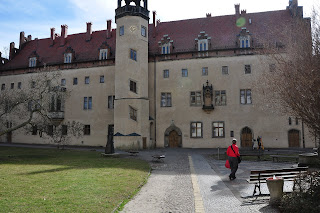 Melanchthon's House was closed for renovations(!), but it was cool to see how close together they were. In Wittenburg we really got a sense of all these people moving about their small city for work and food and conversation, and in it all shaping this great movement that changed the western world.
After leaving Luther's house (at the opposite end of the city from the Castle Church) we walked to an oak tree that marks the spot where Luther burned his excommunication order. Walking back toward the city, we stopped at the place where the Esler gate had been. Here, right by his house, Catherine and all the city came and met Luther's body when it was brought here from Eisleben. As they led it through the gates the church bells began to ring and they all rang as the entire community walked with Dr. Luther one last time to his funeral in the Castle Church where it all began. Here's a picture of that place (the gate no longer exists):
 On our way back to Quedlinburg there was a glorious sunset with lots of contrails from jets flyinging in and out of Berlin, all set behind the ubiquitous windmills
 :
Eisleben was, in many ways, disappointing. Although the museum was good (especially whoever did the Luther quotes that went with various displays), the people at the information desk and the museum front desks were really rather indifferent to anyone who showed up. Not only there, but in other places, we've had some trouble asking questions, even with people who speak English. No one seems to care very much about the wonderful museums in which they work. This isn't universally true, but it has often been thus in our experience these last two weeks.
Eisleben was really that way. The town itself seemed kind of depressed as well. Then the Luther death house was closed for renovation, as was the church there. This is another thing we're running into. They are really gearing up for the 500th anniversary of the Reformation in 2017. There is advertising for it everywhere. So lots of things are being fixed, which is nice, but it also means many things are closed. And they don't tell you about that when you get the tourist map and all.
But it was wonderful to see all this history. Here's a picture of the font where Luther was baptized, now in the Geburtshaus Museum:
 Wittenburg was a different experience. We enjoyed the very good English booklet walking us through the streets and to all the sites. It was very moving to go into the Castle Church where Luther had posted the 95 Theses and stand at his and Melanchthon's graves. (The Germans are very good about keeping their graves with fresh spring flowers - very simple and lovely.) I think Luther would like the fact that this church, where the first "protestant" worship service was held, is still a Roman Catholic Church. And "Ein' Feste Burg" is painted in huge letters around the tower.
It was also terrific to visit the Town Church where Luther preached more that 1000 sermons! Here's a picture of the pulpit with a painting of Luther:
 The museum in Luther's house is excellent, and it has the best collection regarding Luther. It was amazing to see the library with all the books that are still extant from Luther's period and since. (You view the Library through sealed, thick windows from a hallway.) The descriptions of Luther's day-to-day life, and of his relative wealth (I really didn't know that) were very interesting. Here's a picture of Luther's house from the courtyard:
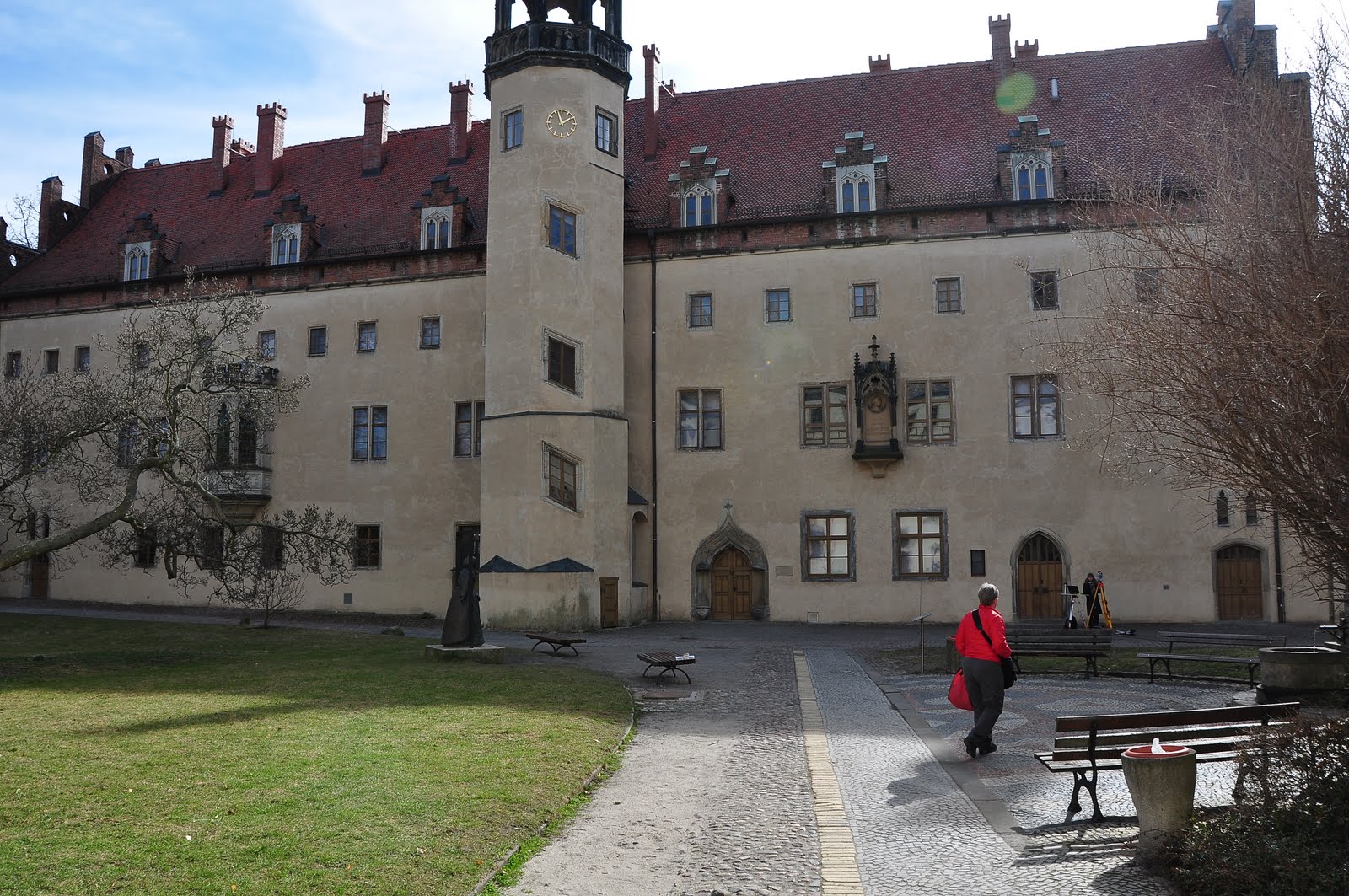 Melanchthon's House was closed for renovations(!), but it was cool to see how close together they were. In Wittenburg we really got a sense of all these people moving about their small city for work and food and conversation, and in it all shaping this great movement that changed the western world.
After leaving Luther's house (at the opposite end of the city from the Castle Church) we walked to an oak tree that marks the spot where Luther burned his excommunication order. Walking back toward the city, we stopped at the place where the Esler gate had been. Here, right by his house, Catherine and all the city came and met Luther's body when it was brought here from Eisleben. As they led it through the gates the church bells began to ring and they all rang as the entire community walked with Dr. Luther one last time to his funeral in the Castle Church where it all began. Here's a picture of that place (the gate no longer exists):
 On our way back to Quedlinburg there was a glorious sunset with lots of contrails from jets flyinging in and out of Berlin, all set behind the ubiquitous windmills
 :
Thursday, March 24, 2011
Quedlinburg
We arrived in Quedlinburg, Germany on Monday afternoon, March 21. We’ve rented an apartment here for week. What a good find this was! This town is beautiful. It is full of old half-timbered houses, and in fact the German half-timbered house museum is located here. It managed to escape both the ravages of World War II and East Germany, so has maintained its historical character. It seems to be an arts town - lots of visual arts and music - and our apartment is up above an antiquarian bookstore. Perfect. Here are pictures of the bookshop and the upstairs area:

 Downstairs is the kitchen, bathroom, and eating area. Here’s a picture of the stairs:
 We’re careful.
From here we’ve driven to Eisleben and Wittenburg and have seen much of the countryside around this area. Quedlinburg is on the north edge of the Harz Mountains, and so is a favorite stopping place for people going hiking and camping there. We drove down from a high mountain ridge the other day, and it was a beautiful, forested road. Although Spring has officially begun, the trees around here have not really begun to leaf out. But you can see it coming. Everywhere we go people comment on the effects of the very hard cold winter they all had and how late the springtime blooms are. But everyone is getting ready, and we see gardeners hard at work in the home plots as well as their amazing pea patches! Those have little houses with satellite dishes and all - quite amazing! It looks like people come to garden and really settle in!
On our first night in Quedlinburg we ate at a local Italian restaurant. The young women at the table next to us heard our English and talked to us a bit. They had been on a two-day holiday from their homes in Hannover. They gave us a couple hints for the area, which was nice. But they also commented on how unusual it was to have American tourists around this region, or in Germany at all. We have discovered that not many people speak English, but everyone is game to try with us, and my little dictionary comes in handy! (My German is non-existent.) It just all adds to the adventure.
Our apartment does not have internet, but a nearby hotel graciously allowed us to get hooked to their wi-fi. So we’ll go over there and have another cup of coffee and get this posted. I’ll write about Eisleben and Wittenburg later.
Lüneburg and Starup
On Friday, March 18, we headed north in Germany on our way to Denmark for the weekend. We stayed Friday night in Lüneburg on the recommendation of one of our neighbors. What a wonderful town! We had a terrific German meal at Das Alte Brauhaus Friday night, and then spent some of Saturday morning exploring the town. It was market day, and Larry had lots of fun taking market pictures. Here’s one of them:
 There was a little shop with lots of sheep stuff (!) called Nanu Nana, so we bought a couple things and Larry took a picture of this Nana:
 There was a museum about salt mining there, and we walked over to see if we could manage it before we had to leave, but it was too much time. The whole history of salt throughout Europe is very interesting and we may get to one museum/exhibit about it before the trip is done.
On Saturday afternoon we arrived in Starup, Denmark to visit our friends Pastors Margaret Hammer and Jørgen Kappel-Hansen. Starup is in Jutland not too far north of the German border. Jørgen is the pastor the Starup Kirke, which is 1000 years old. It sits out on the shore of an inlet coming in from the Baltic Sea, and is a beautiful location. Here is a picture of Margaret and Jørgen inside the church after worship on Sunday:
 Worship was lovely, even though we couldn’t understand any of it! I could sing along from the hymn book (words only) with Norwegian pronunciation. Two tunes (including A Mighty Fortress at the end) were recognizable, but as every hymn had about 9 verses, I picked the tunes up eventually. (It’s a good thing Grundtvig wrote long hymns!) The church was full, and there were two baptisms: an infant and a confirmation student. We sat behind the group of confirmation students, who are required to attend worship in the last couple months before they are confirmed in May. That was fun - not much different than home at that point!
On Sunday afternoon they drove us into the nearby large town, Hardeslev. (Mysteriously pronounced “Hest-lay-oo”) Margaret is on the staff of the Domkirke (cathedral) there. It is an ancient building (12th century) and a beautiful room. The paraments and paired chasubles are all made by the queen of Denmark. She is a textile artist who does this work for cathedrals throughout the country. Often she uses her old ball gowns for fabric. Here is a picture of the red chasuble:
 We had wonderful meals with great conversation in the Starup Praestegaard house. The house is also quite old, although the church has done a great job of upkeep. All the roofs are thatch, which is it’s own headache, but it seems to do well. I found it amusing a delightful that our accommodation there were two very comfortable portable cots in the Confirmation Room! Made me think of all the visiting groups (and Faith’s own youth) that have slept in the Confirmation rooms at Faith! Here is one more picture from Starup - the church:

Subscribe to:
Posts (Atom)
